
Gates City Directory Collections
Gates does not have a verified standalone historical directory index. Its strongest directory trail is regional. Rochester Public Library holds the key shelves and digital runs, while NY Heritage supplies a searchable route into many older Rochester volumes. A Gates household may appear in a Rochester book, a suburban directory, a county volume, or a telephone book, depending on the year and the publisher's coverage. The useful question is not simply whether a surname appears, but whether the volume actually included the town at that time.
| Collection | Years | Where held | Access |
|---|---|---|---|
| Rochester city directories | Begins 1827; digitized collection through 1946, with gaps | NY Heritage and Rochester Public Library | Online PDFs where digitized; original volumes at Rundel |
| Rochester House Directory | 1892-1920, 15 volumes | Rochester Public Library Local History & Genealogy | Address-to-householder source; in-library or digitized by volume |
| House section in main directories | From 1922 | Back of the principal Rochester directory volumes | Street and house-number lookup; suburb coverage varies |
| Regional suburban and telephone directories | 1930-1940 suburban run; 1912 Bell directory; county volumes for 1869 and 1918 | Rochester Public Library regional collection | Check the title and individual year before relying on a match |
| Gates Historical Society archive | Exact year span not published | Hinchey Homestead | Research assistance by request or appointment |
Gaps are expected. The digital collection's 1946 endpoint does not mean every year is present, and a Rochester title does not promise a Gates listing. Keep the cover or title-page details with every citation. That small habit prevents a later researcher from treating a regional or city-only volume as a townwide census.
Gates City Directory Shelf, 1827-1946
Rochester's bound directories begin in 1827. The digitized run identified by the library and NY Heritage reaches through 1946, but the individual years are uneven. Known appearances include selected 1830s, 1840s, 1850s, 1860s, 1870s, 1880s, 1890s, 1912, the 1920s, 1930, 1931, and 1941. That pattern makes a one-year-at-a-time search safer than assuming an annual run. For a Gates search, the regional suburban directories from 1930 through 1940 deserve special attention because they explicitly include Gates.
NY Heritage's Rochester city directories collection shows the digitized directory material that anchors this shelf.
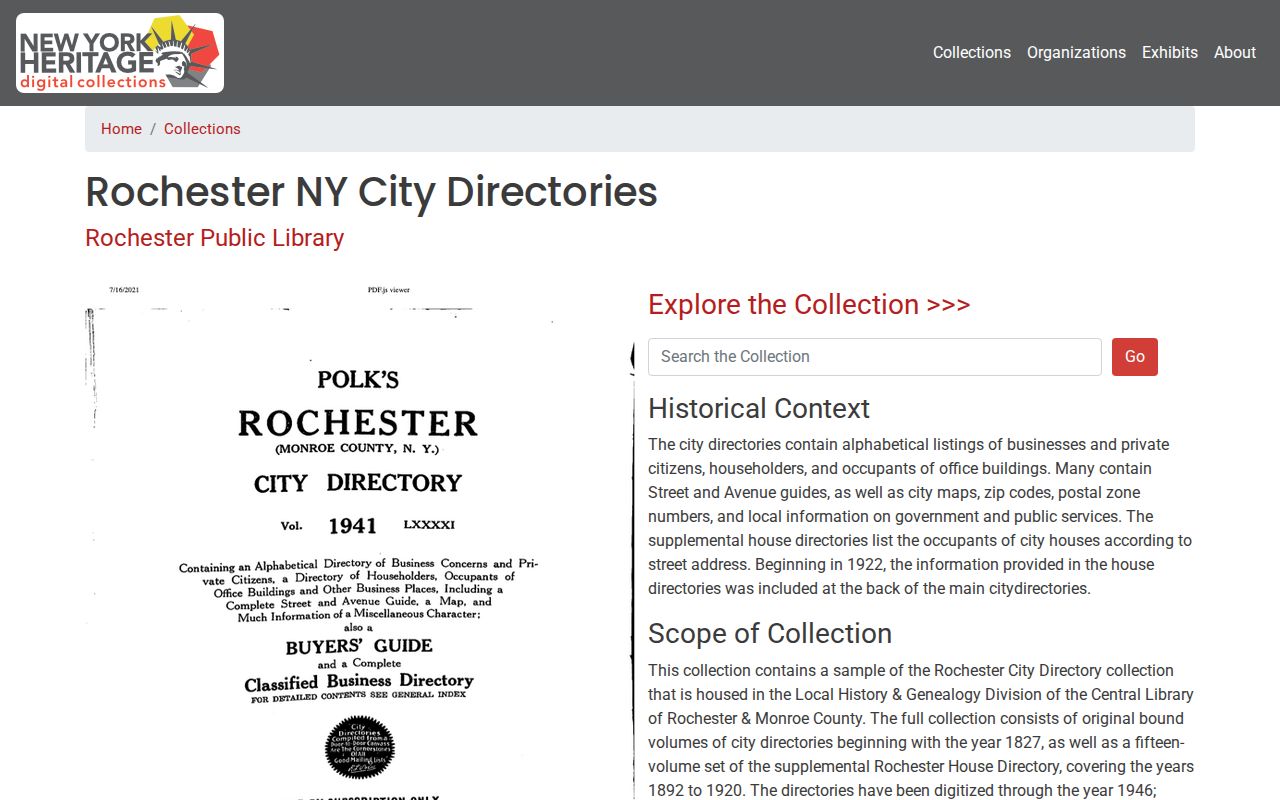
The collection helps establish whether a volume is available online. Once a relevant year is located, use the volume itself for the page, section, and listing details rather than relying on a collection summary or an OCR result alone.
R.L. Polk & Co. is credited in the collection metadata for many volumes. The publisher's 1941 introduction describes separate alphabetical, classified, and householder or street-guide sections. It also identifies maps and civic-reference material. Those divisions matter because a surname search and an address search do not start in the same part of the book.
Note: A Gates address may be absent from a Rochester-named volume even when the household lived in the present town area.
Gates City Directories Beyond Rochester
When an alphabetical Rochester volume misses a Gates person, shift to the regional shelf instead of treating the absence as an answer. Rochester Public Library identifies a 1912 Bell Telephone Directory covering Rochester, Charlotte, Henrietta, Gates, and Victor. It also lists Monroe County directories for 1869 and 1918, a Monroe and Livingston farm directory from about 1917, and several business directories. These sources place people in the service and county geography used at the time.
The 1930-1940 suburban run is especially useful because it names Gates among the included suburbs. A telephone listing is a different kind of evidence than a householder line, and a county directory is different again. Record the publication title, the stated geographic scope, and whether the entry is alphabetical or address-based. A telephone number, where printed, belongs to that historical volume only and should never be read as current contact information.
Rochester's postal identity can also blur the trail. Gates Town pages use Rochester, New York mailing addresses, while the town remains legally separate. Earlier town boundaries changed as Rochester annexed territory, including a final 1919 boundary change. A historic line may therefore carry a place label that is not today's municipal wording.
Read a Gates City Directory Entry
A directory line is compact. Read it against the section heading and the abbreviation key before turning it into a family conclusion. The 1941 Polk introduction places the alphabetical name section before the householder and street guide. It explains that streets are alphabetized, numbers are ordered numerically, and names sit opposite the relevant numbers. The guide also describes a printed home-ownership designation. A line can identify a listed person, a firm, or a historical address. It does not establish legal ownership or every person at that address.
| Listed name | The spelling, initials, and marital or spouse notation supplied by the publisher. |
|---|---|
| Street address | The historical number and street as printed. Preserve it exactly, including abbreviations. |
| Firm or profession | A business association or professional notation when the entry includes one. Treat it as a historical clue. |
| Householder or street-guide line | The reverse, address-ordered entry that places names opposite house numbers. |
| Ownership designation | A printed indicator noted by the volume's guide, not a substitute for a deed or assessment record. |
- Criss-cross section
- An address-ordered section, often called a street guide, used to move from a street and number to a listed name.
- Householder index
- The portion of a directory organized around addresses or householders rather than a simple surname list.
- Abbreviation key
- The publisher's explanation of shortened words and symbols, usually near the front of the volume. Photograph or note it before interpreting entries.
Read the whole line and its immediate neighbors before making a note. A street guide can reveal a number sequence, an intersection, or an abbreviated surname that changes the first interpretation. Keep the section and page with the transcription so another copy of the volume can be checked later.
Trace a Gates City Directory Household
A careful Gates city directory trail follows the source, not just the surname. Address changes, initials, spouse notation, and the street guide can separate people who share a name. Census records can add a dated household snapshot, while a recorded deed can answer a different question about the parcel. The Gates resident lookup route is more useful when the task is confirming one named person through current official records rather than rebuilding an older directory trail.
- Write the person’s name, the printed address, the directory year, and the exact source title. If an old street spelling or number appears, keep that version too.
- Search the alphabetical section for the person, then move to the street or householder section to read the nearby numbers and names.
- Check the next available year backward or forward. Test first initials, middle names, former surnames, spouse notation, and close relatives before joining two similar entries.
- Pair a directory hit with the closest released federal census year. The census and directory use different dates and purposes, so compare rather than merge their facts.
- Use a deed, tax record, obituary reference, or probate file only for the separate fact it can support. A missing directory entry can reflect a gap, an abbreviation, a move, or a decision not to list.
For a disappearance, the Rochester Newspaper Index can locate an article reference for 1818-1897, and the Local History division holds an 1898-1903 card catalog. The index is a lead, not the full story. The library offers article-copy requests, subject to its stated per-form limit, and the original notice should be checked against a vital or probate source when the fact matters.
Gates City Directory History at Hinchey
Gates Historical Society offers a local shelf that complements the regional books. Its archive of historical and genealogical material is available on request, though no public searchable name database was located. That makes the Society a place to ask focused questions about a family, road, building, or local history, with the directory year and address already in hand. Broad requests for every mention of a surname are less likely to produce a reliable answer than a documented, narrow request.
The Gates Historical Society's Hinchey Homestead page documents the local historical setting and research route.
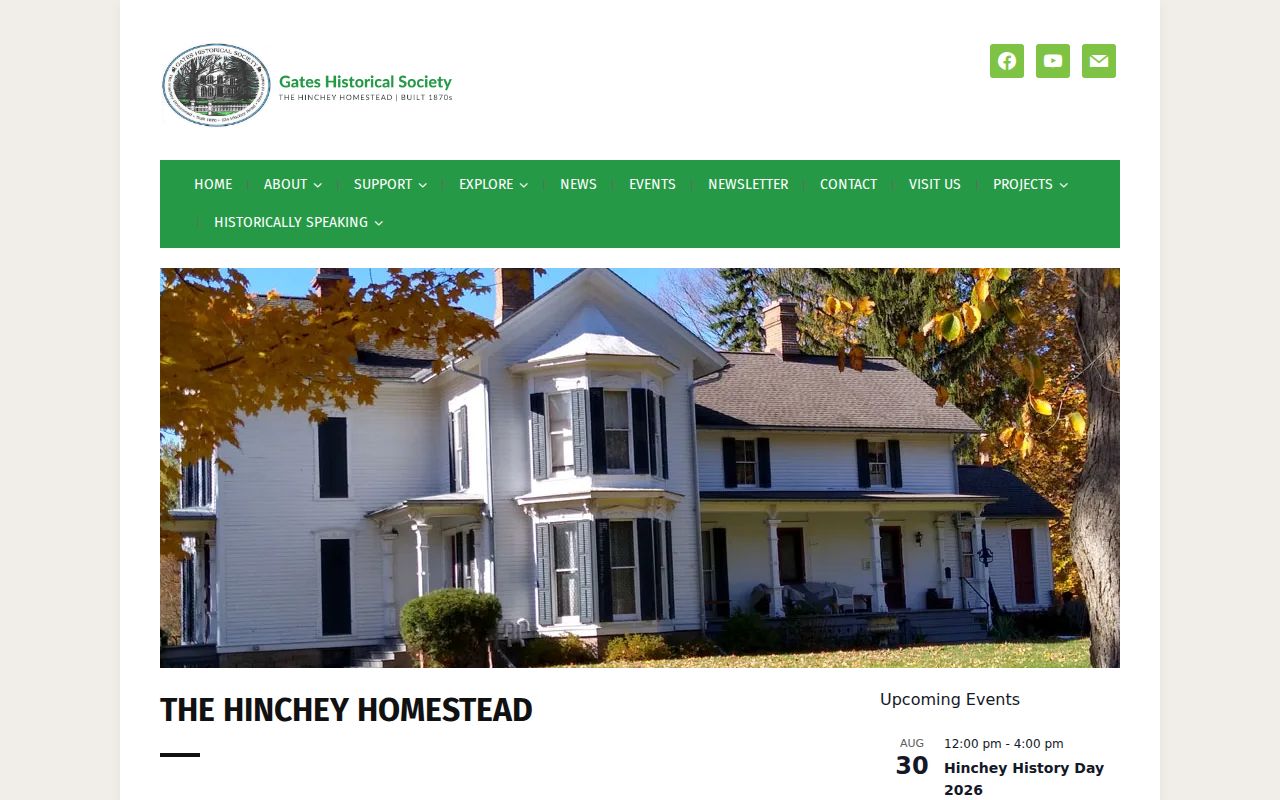
The Society manages the Hinchey Homestead at 634 Hinchey Road and says its archive can be consulted by request. The house offers a concrete local comparison point for historical research: William Hinchey settled nearby around 1810, Franklin built the surviving homestead in the 1870s, and the family connection continued into the late nineteenth and early twentieth centuries.
Gates Records, Boundaries and Directory Dates
Directory research works best when the reader knows which custodian was in place. Gates was incorporated in 1813, then entered the Monroe County records context when the county was created in 1821. Rochester directories begin in 1827, but Gates territory and Rochester boundaries did not remain static. The county and town history explains why an older source can use a different jurisdictional label without describing a different family.
- 1813: Gates was incorporated during its Northampton and Gates-era town government.
- 1821: Monroe County was created, moving the county-level deed and naturalization trail into the Monroe custody context.
- 1827: Rochester city directories begin, with later gaps in the surviving and digitized runs.
- 1892-1920: The Rochester House Directory series supplies address-focused volumes.
- 1922: House information enters the back of the main Rochester directory.
- 1930-1940: Regional suburban directories specifically include Gates.
Digital access is much newer than the books. The online collection reaches selected directory volumes through 1946, while the Monroe land-record image system is largely a later source. A nineteenth-century name may be discoverable through a directory but still require a library, archive, or county counter visit for supporting records.
Limits of Gates City Directory Research
Directories have OCR errors, publication gaps, abbreviations, and uneven suburb coverage. An entry can be a historical householder, a business line, or a person associated with an address. It is not a present-day resident list. The research record also does not establish a Gates-wide sequence of old street renumbering, so do not apply Rochester's documented 1884-1885 numbering change to every Gates road without separate evidence.
Rochester Public Library's Local History & Genealogy division is at Rundel Library, 115 South Avenue. Materials do not circulate, and special-collection appointments are recommended. Construction and offsite microfilm digitization can affect availability. Its newspapers, maps, directories, and Life Records index are valuable follow-up tools, but access to some databases varies by location or eligibility.
Note: Cite the printed year and page even when a PDF is searchable, because OCR can misread initials, street names, and older type.
Confirming a Gates Directory Lead
Use a city-directory line as the beginning of a documented trail. The library's house-history worksheet pairs a historical address with maps, directories, assessment information, recorded transfers, permits, and other sources. The order matters. Start with the historical printed address, then test whether the street name or number changed, and finally locate the parcel or legal description that carries forward. A deed establishes recorded parties; an assessment roll records owner and mailing fields; a census describes a household at its own date.
RPL's house-history worksheet lists the practical fields to preserve: source year, street-name differences, map title, lot details, directory line, and grantor or grantee details. It keeps an older Gates city directory useful without asking it to prove facts that belong to another custodian.